
Winter Deer Browse: Gratitude for Life in a Time of Darkness
I am writing this email in the days leading up to winter solstice. This significant time of year, recognized by all cultures in regions north of the equator, having the shortest days and longest nights of the entire year.
As we reflect on and celebrate the season behind us, those of us that can find time and space to rest heed the circadian calling, some of us welcome the dark as an invitation to journey deep within to kindle inner fires and ultimately many of us are praying for and inviting the return of the sun so that we can be re-born, re-warmed and re-invigorated for the coming season ahead.
Sometimes I wonder back to my ancient ancestors, at least the ones who lived in temperate climates, for how could they brave the cold weather? I am sure the colder weather was on the front of mind this time of year. I am so lucky to be human and to have been born into a time of domestication so that I can appreciate a warm, insulated house.
The wildlife do not know the modern domestic comforts. They speak to the wild part inside me that is sometimes more quiet, but who is very much alive and part of my deep sense of self. Surely the wildlife must have their own wild comforts.
When I see the deer moseying around nibbling their daily buffet and the bushy tail squirrels skittering busily up and down the trees and digging here and there I know that they are at home. Indeed they appear very comfortable. Except perhaps at the harshest, coldest times of year they do look comfortable.

Maybe even at those times when the does and fawns are hunkered down in their sheltered spots around their matriarch, maybe even then they they know some comforts that I cannot yet perceive or understand in my domesticate brain.
This winter started off a lot different than last winter. Our transition from fall to winter was very long and smooth. Fall was luxuriously warm and we had plenty of time to get veggies in from the garden. Likewise the deciduous trees took their time to change colors and drop.
The full symphony of yellows, reds, oranges, browns and greens changing color, fluttering and dropping from trees took well over a month across all the various species. The oak trees especially were green the longest and were among the last trees to finally drop their leaves.
Oh oaks, you wise, special trees, you are the last to leaf out and the last to drop your leaves. Some of the other deciduous trees like maples and chestnuts may have held on to their leaves a bit longer if it weren’t for the deluge of rain we had in late November. It was a very wet start to fall and the ground was finally saturated with moisture and will now stay moist for months to come.
I felt a huge sigh of relief from the landscape, plants and animals.
The sigh of relief came out of myself as my body relaxed into the new season. The finally moist soil, the end to the fire season (especially after the fire that was so close to home this year), the leaves falling down symbolizing renewed and the knowledge that rest and change are at my doorstep.
Last year the transition was so different. We an early surprise snowstorm dump many inches of snow overnight before most deciduous leaves had even the slightest hint that they were about to change color. Thousands of leaves held snow and the weight pulled branches down. Huge limbs snapped, trees fell over driveways, smashed buildings in some cases. It happened so fast last year and the feeling of seasonal transitions was so different.
What were the wildlife thinking as the trees dropped their massive limbs to mulch the forest floor? Sky habitat to soil habitat. Sun eater to soil food. Eventually transmuted, eaten and carried down, covered and buried under layers over the years. From the light into the deep dark.
Perhaps the deer were ecstatic to have green leaves at the ground that they wouldn’t have been able to access otherwise. Or perhaps they just rolled with it as their ancestors have all learned to do across time and space, in order to survive the varying seasons and conditions that would present themselves in any given year.
In the riparian areas there are often alder trees growing along river and creek-sides. Alders are fast growing trees that actually fix nitrogen into the soil. Their beautiful dark green leaves with serrated edges have a texture that is almost like ripples or waves—the leaf goes down at the veins and then up again, unlike other leaves that are flat.
The alder leaves here drop when they are still varying shades of green and is the only tree I can think of right now that drops green leaves. Their leaves carpet the ground below and nourish the soil and river life alike.
In November I enjoyed watching a family of deer down by the creek casually eating mouthfuls of green alder leaves. “Of course!” I thought, those green leaves must be a welcome delight and seasonal treat that only lasts a few weeks at most before the wet leaves mat, start decaying and begin to melt into the ground while the grass eventually grows through them.
Deer courtship started early too this year. Was it the warm weather? Or perhaps more likely, I just happened to luck out to observe it earlier than I had in the past. In a weeks’ time I lucked out to see several different bucks, on separate occasions, courting the ladies.
One large six pointed buck seemed to be in so much of a hormonal intoxication that his long tongue hung out the side of his mouth and followed his doe of choice, looking almost in a trance.
Though he did have some moments of fulfilling duty, between his trance like movements he paused at a high point to observe me, protectively between the more shy retreating doe and myself.
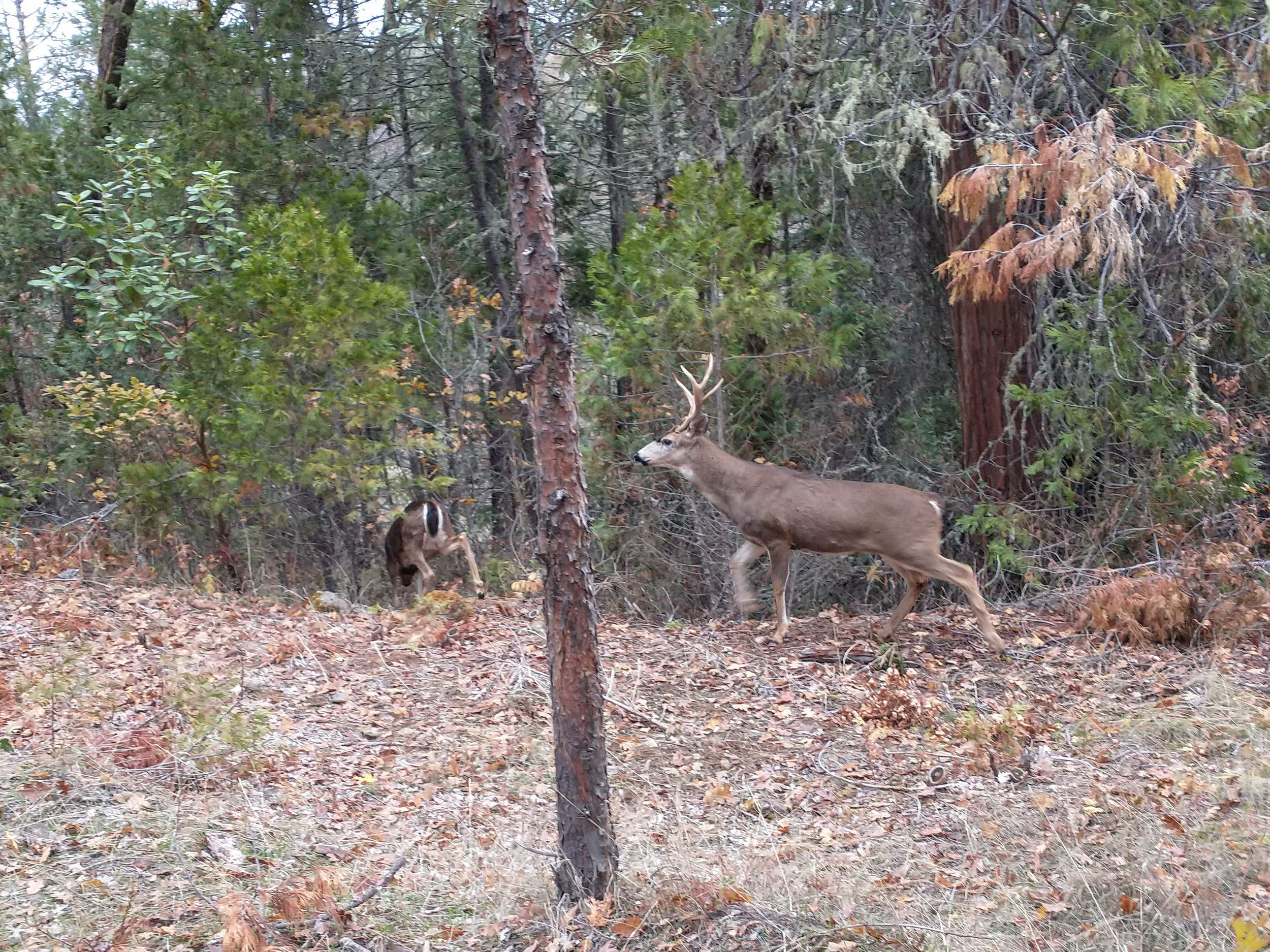
Another day I witnessed a smaller four pointed buck, head lowered and carefully approaching a doe, almost as if to beg her. She was fairly dismissive and moved on confidently to continue her business and this seemed to go on a little while before the buck lost interest, or perhaps took a break.
Not too long after that the bucks disappeared from my sight. Perhaps they are becoming more reclusive to protect the sensitive nerves in their antlers as their velvet sheds. Sure enough in early December I was noticing the obvious signs of fresh buck rub, especially on willow trees.
I feel lucky that none of my fruit or nut trees have met the devastating fate of buck rub to this day, and I hope to keep that record intact. So far my protections against buck rub have proven effective.


With less food around I always wonder what the deer are eating in the winter. As I mentioned in the fall deer browse post, the acorn drop was much less this year compared to last year’s mast. Now the acorns have already been long gone for months.
In our climate, winter is cold but not extremely harsh like it is even further North. Sure enough, at higher elevations in our valley, mountains are already coated with snow. Here in the foothills, lower down, it is common to have many, many freeze thaw events throughout the winter.
While the deciduous trees have lost their leaves and in many places grass is just starting to grow but is not very long at all yet. Deer must rely on what evergreen leaves they can find as well as hardy herbs and tender young tree buds.
Our Pacific Madrone offers green leaves year round and deer have free access to leaves from smaller trees or trees that have sprouted new growth from the base or damaged trunks. One of our local Ceanothus, otherwise known as buck brush, has tiny ever green leaves that offer some forage through the winter.

Because deer love variety, they’ll take as much nutritious variety that they can get. I enjoyed watching a deer this winter and learning that it loves to eat lichen. Lichen grow on the dead branches of various native trees. After the rains, lichen and lichen laden twigs and branches fall from the trees to the ground below.
Lichen, a seasonally available vegetable raining down.
The deer sniffs it out and eats lichen by the mouthful, even picking up small twigs and munching the lichen off of it.

The local deer also love eating our native honeysuckles, evergreen vines that grow here in Southern Oregon. The honeysuckle vines sprawl along the ground until they find a tree or something else to climb. Sometimes they luck out, a few vines can get established on a tree and create a ton of growth up in the canopy.
On the ground and within browse height the honeysuckle vines are a winter delicacy. Not only do deer nibble the leaves, but they know how to put their teeth over a vine and move their head to strip off a bunch of the small leaves into their mouth at one time.
How smart and resilient you are deer!

By this point in December the deer are not messing around. They are taking food where they can find it before things get even colder and food is more scarce. (To be honest the deer don’t mess around with food any time of year!)
Their winter coats have come in and they have more of a fluffy appearance. You can sometimes see the “deer licks” in their fur where they have groomed themselves. It has an almost velvet appearance and looks so much warmer than their summer coat.

I am always amazed to see the deer live naturally and roll with the seasonal changes on a day by day basis. Often our brains are so concerned with how domesticated we can be, how efficient we can make things and how comfortable we can be.
The deer look so different than us, because we don’t recognize their wilder comforts. I mean, when was the last time we slept outside naked in the winter?
Yet we also relate because we know a comfortable, easeful mammal when we see one, cloven hoofed or not. We can relate to their awareness, looking out into this world through two eyes. We can relate to their hunger and voracity. We can relate to wanting to be warm in the winter. We can relate to raising, nurturing and protecting our young. The vitality within us relates to young fawns bounding youthfully, expressing their overflowing vitality.
Many a doe are now pregnant or will be soon. The fawns of yesteryear are now nearly fully grown. Before we know it a new cycle will become obvious when the fresh, spotted little ones make their appearance.
With the soils wet and the trees’ leaves dropped I have another reason to rest this winter.
Our young fruit and nut trees are dormant, well hydrated and resting. They need little care this time of year. I know they are protected from hungry deer that might otherwise take a nibble of their tender buds. Our domestic trees are otherwise nondescript without their leaves.
Truthfully, a few trees, out of the dozens and dozens that I planted in the presence of deer, did suffer some unexpected damage this season. A few young trees received repeated grazing of their leaves before I noticed and the deer showed me where there is still some weakness in the boundaries that I set between my trees and the deer.
Those trees will survive, but of course I prefer less browsing on my young trees when possible. I am learning every season from the trees and from the deer. I appreciate them both as part of the landscape. The wild deer who were here long before I arrived and the domesticated trees I planted.
In some ways the non-native fruit trees I planted represent myself. I am inserting myself into the landscape, a non-native domesticated man interfacing with the wild nature. That wild part deep inside myself longs for more time connecting with nature and so does my heart.
My heart accepts the damage on my fruit trees and gently acknowledges my ego’s desire to turn it into a big deal, a battle perhaps, or a sadness over something precious that had been taken from me. My heart reminds my ego that I am safe and everything is OK. It helps my brain remember that everything is food for something else, like I will eventually become food for trillions of microorganisms and ultimately, certainly indirectly if not also directly, become part of the bodies of larger organisms too.
I thank the deer and the trees around me for helping me connect, for being ever patient and non-judgemental with me as I stumble about on the Earth, scratching her surface with my domestic tools every season so that I can learn where my sustenance comes from, and learn again how to be human—holding gratitude in my heart for this precious moment that we call life.
Happy winter solstice friends! I hope it is a magical time for you and your loved ones.
Protect Fruit and Nut Trees from Deer and Rodents
Want to grow trees more naturally in the presence of deer? You don’t need to install a costly deer fence around your entire orchard or property. Protect your fruit and nut trees individually from deer. Fine tune deer protection based on your goals, habits of your local deer and any inherent deer resistant qualities within your trees. Allow deer and other wildlife safe passage through the land you steward.
See our course Protect Fruit and Nut Trees from Deer and Rodents for more details!
Recommended Reading
- Spring Deer Browse: Observing the First Bites of the Season
- Summer Deer Browse: Protecting Trees When Other Food Is Drying Up
- Fall Deer Browse: Land, Life and Equanimity

Got Deer? Read on!
Want more stories and tips about gardening in the presence of deer? Our family has been doing a lot of experimenting with deer resistance of herbs, flowers and fruit & nut trees. Come learn with us… browse our archive of articles about how we garden with deer!
2 responses to “Winter Deer Browse: Gratitude for Life in a Time of Darkness”

Hi Noel, It’s so nice to read something that is not filled with angst about deer. When you talk to someone trying to grow landscaping or food (don’t you think they should be synonymous? But I digress…) anywhere in this valley they lament the constant browsing of deer on their precious plantings. I like your take on this, and how your “heart reminds your brain” that everything is food for something else. So often as gardeners we take an angry approach – us versus them – to pests (Bermuda grass and box elder beetles are two that come to my mind), rather than considering the pursuit as a whole cycle of birth-growth-death-rebirth… ah, but remind me of this idea when I am ‘battling’ squash bugs next summer!
Thanks for sharing your thoughts Dana! I am glad we can relate about battling and trying not to battle. For me, it’s definitely a work in progress and this blog post and the memory/mantra that “everything is food for something else” helps me get back on the path or remember what I had learned in some other “peaceful” gardening moment. Usually for me its a relationship with efficiency and weeds are holding me back from having an efficient experience in my garden, and if I think the weeds are “winning”, or fear them “gaining ground”, I can start to worry my efficiency will suffer in the next season. Meanwhile they are just doing what they do so beautifully and I’m over here having a battle with myself! I try to remember efficiency is not why I love gardening, which is not always easy for sure! It’s a coincidence you mention bermuda grass… I wrote about my evolving relationship with grass as a weed or battle in I am an Imperfect, Impure Gardener… you might enjoy that one (or curse me) next time you’re pulling grass :)







Share Your Thoughts