
Table of Contents
Heirloom Seeds, What Are They Really?
Gardeners are often faced with the decision of choosing what category of seeds to purchase for their garden. Many gardeners swear by heirloom seeds as the best, in contrast to choosing modern hybrids for example.
Heirloom seed, aka heirloom variety, is an easy concept to understand, But it is also somewhat subjective, so it can also be a confusing concept at times, even to long time gardeners.
Table of Contents
What is Heirloom Seed?
Heirloom seeds hearkens an idea of old family seeds, such as a family heirloom, or a community heirloom, such as in a tribe or regional community of people. In fact many gardeners do define heirloom seeds in this way:
Heirloom seeds are seeds of a variety of plant that have been passed down in a family, or community for generations, often of cultural significance.
Over time many heirlooms that are commonly distributed in commerce and among gardeners are no longer stewarded by the families or communities where they originated. Yet they continue to be stewarded by seed farmers and the gardening community at large. Perhaps that is why we have another definition of heirloom seed, more specific to time rather than origin:
An heirloom is a plant variety that has been in existence for at least 50 years and maintained to retain distinct traits such as appearance or flavor.
In other words we are talking about varieties of vegetables, flowers or herb seeds that were grown and stewarded for at least 50 years. Those varieties were maintained to continue to resemble the same traits today.

When I started gardening, my concept of heirloom vegetable varieties was that they went back a long time, prior to industrial revolution, back to the days of homesteading of the 1800’s and even further back in many cases. I was thinking of family heirlooms that were passed down for generation after generation after generation, like the first definition above. In practice though, there is a lot of flex and even debate as to how the term should be used.
One school of thought places an age or date point on the cultivars. For instance, one school says the cultivar must be over 100 years old, others 50 years old, and others prefer the date of 1945, which marks the end of World War II and roughly the beginning of widespread hybrid use by growers and seed companies. Many gardeners consider 1951 to be the latest year a plant could have originated and still be called an heirloom, since that year marked the widespread introduction of the first hybrid varieties.
Heirloom plant, Wikipedia
If we subscribe to the 50 year rule and we don’t require that heirlooms aren’t necessarily passed down in a family, we open up the possibility for heirlooms to include varieties that came out of university research or corporate breeding in the mid 20th century. This does happen and the appropriate term is corporate heirloom seed, to distinguish such seed from varieties that did indeed originate in family gardens and farms.
I understand the reason for the 1945 or 1951 cutoff dates, but it assumes that no new modern heirlooms are allowed to originate under that definition. But all the past heirlooms were modern at the time their seed were first saved. So what does that mean for the future of the seed we are saving now?
What I like about the 50 or 100 year rule, is that it is a sliding measurement allowing for development of new family heirloom varieties over time. Every gardening family, every seed saving family, such as yours and mine, has the right and ability to save and pass down seed from generation to generation, and that seed should rightfully be called heirloom seed. Whether or not that variety has value to gardeners outside of the family is another story.
To add another interpretation to the mix, the highly respected Seed Savers Exchange organization has their own definition of heirloom:
An heirloom is a variety that has 20 years of documented stewardship and is not restricted to being maintained by one individual or family during that time. (source)
The key phrase there is documented stewardship. They then go on to define seeds introduced prior to 1950 as historic.
“Heirloom” describes a seed’s heritage, specifically a documented heritage being passed down from generation to generation within a family or community.
What Are Heirloom Seeds? – Seed Savers Exchange
So we can start to see some of the subjectivity about what a heirloom seed is. It all has to do with differentiating older varieties grown with careful stewardship from modern varieties and especially from modern hybrids and especially from modern GMO varieties. Let’s find the commonality and summarize. What do all these definitions have in common?
Heirloom seeds represent varieties that are at least a few decades to a century old, passed down for generations by family members or community seed savers and carefully stewarded to represent the quality and traits that the variety is known for.
Additionally:
Seed of modern hybrids and GMO varieties cannot be considered heirloom seed.

Why Heirloom?
The concept of heirloom seed is relatively new. Prior to industrializing seed, there were mostly heirloom varieties of seed that were maintained by families and communities. Back then they weren’t called heirlooms, they were just distinct varieties.
The term heirloom to describe a seed variety was first used in the 1930s by horticulturist and vegetable grower J.R. Hepler to describe bean varieties handed down through families.
Heirloom plant, Wikipedia
When modern industrial commercial hybrids started becoming more prevalent, the need for the term Heirloom became necessary to distinguish from modern commercial hybrids, and later GMO hybrids.
Hybrids in themselves are not bad, after all, all heirloom varieties started as hybrids. (More on that in a future blog post.) But some modern commercial hybrids come with baggage such as corporate greed and lack of ethics. New hybrids also haven’t necessarily proven themselves through the test of time.
It’s true that heirloom varieties have proven themselves through time. In fact with all the loss of biodiversity, over the past century especially, we can conclude that the heirlooms from 50-100, or more years ago that are still available today, have so far survived going extinct because they have offered consistent value to a lot of gardeners. Thank you gardeners for saving seed!
Reasons why heirloom seeds may survive the test of time include:
- Amazing taste, texture or visual beauty
- Adaptable to a wide variety of conditions
- Vigorous or strong growth habit
- Good resistance to pest and disease
- Familiarity
- A heartfelt, relatable or otherwise good origin story
- Authentic relationship
Heirlooms Are Inbred to Some Degree
Here is another definition of heirloom from Joseph Lofthouse, out of left field to shake things up:
An heirloom is a variety that has been highly inbred for decades, and is maintained by continual inbreeding. It may have been the perfect variety for one family or tribe, that lived a very long time ago, in a place far, far away. Because heirlooms are from a far different place and time, they often lack the genetic toolkit to deal with modern conditions.
Joseph Lofthouse, Landrace Gardening
The key word here is inbred. This definition offers some stark contrast to how I understood heirloom varieties and really caused me to question some of my beliefs around heirloom seed. Really it’s looking at the same heirlooms through a different lens.
Now, I realize I took this quote out of context from a whole book (highly recommended by the way) that proposes a way of saving seed that contrasts conventional gardening practices. I’ll share more about landrace gardening in its own post, but for now if you’ll bear with me in the next section, I’ll attempt to shine some light on the potential issue of genetic diversity that Joseph has so brilliantly identified.

Heirlooms and Genetic Diversity
To maintain an heirloom variety, seed farmers plan carefully to prevent one variety’s flowers from cross pollinating another variety’s flowers. This allows the seed farmer to maintain the variety’s distinct traits. If two varieties cross, they would start to look, taste, grow differently in subsequent generations. When that happens, it would be a problem for customers who expect a level of familiarity and uniformity in their heirlooms.
This practice is called isolation. In other words two varieties that may cross cannot be grown next to each other. They are isolated from each other.
Genetically speaking, when we maintain a variety in this manner we are not letting in new genetics. So our heirloom’s variety has a limited gene pool.
When a seed farmer or gardener saves seeds from the same variety year after year without allowing pollen flowing in from other varieties, the variety becomes inbred. This is pretty much the definition of inbreeding in a nutshell: only allow pollen from a plant in the same variety, or the same gene pool, to pollinate another plant.
Inbred plants are closely related to each other. As most of us know, inbreeding can cause problems if we are not careful. This is why most people don’t date their cousins. If ancestors in our direct family line mates with our cousins year after year, we can pretty quickly face what is called inbreeding depression.
Inbreeding depression can cause all kind of problems. Not the least of which is lack of vigor. While it’s not always the case, lack of vigor does show up in heirloom seed, which is why some gardeners prefer to grow hybrids, at least for some of their vegetables.
Hybrids often exhibit what is referred to as hybrid vigor, or the ability to grow more vigorously. Two inbred varieties are crossed together and the sudden inflow of genetic diversity allows for new plant behaviors, sometimes including more vigorous, stronger growth. (See photo of monster carrots above.)
Most seed farmers are aware to one degree or another of the problem of inbreeding heirloom varieties and do their best to prevent inbreeding depression from happening. There are a lot of tools and tricks of the seed farming trade to dance this dance.
Biologically speaking, inbreeding itself is not bad, just as hybrids are not bad. For example, in nature species that are isolated by geography become shut out from genetic exchange with the rest of the world, but can still adapt and thrive. Inbreeding is a gradient with more diversity at one end and extremely low diversity at the other end.
The best seed farmers pay extremely close attention to both what makes a variety special and maintaining a gene pool that is as diverse as possible. These are the seed farmers we gardeners should support with our dollars because they do the hard work of maintaining heirlooms while also providing quality seed in terms of vigor, health, locally adapted, disease resistance, taste, visual appeal, etc.
Hint: The most ethical seed farmers tend to be very small family businesses. More on that soon.
An Heirloom is Not An Heirloom
Many gardeners tend to think of an heirloom as a static, unchanging variety, and for good reason. We may grow the same tomato year after year because we like the way it tastes, we might even like it’s ornamental value and appreciate that it grows well in our garden. When we finally find that perfect tomato we may not want it to change.
Totally understandable! But…
An heirloom is anything but unchanging. Let me clarify, plants and seeds and all life as we know it are anything but unchanging. Even the most inbred heirloom variety has the ability to change. It might not change as fast as as a hybrid variety can with less genetic diversity, but it still changes.
In fact, I’ll go out on a limb and say that saving and planting seeds guarantees change from generation to generation, even in inbred gene pools. Some changes will be obvious while others will be subtle. Some changes won’t even be noticeable to us gardeners, but they are still there. We can count on it.
- Plants (all organisms for that matter) can mutate spontaneously and create new diversity.
- Then there are epigenetics which is a fancy word for saying that plants (and all organisms) can learn from their environment and pass on new information in the form of unique genes to their offspring.
- And we can’t forget recessive genes. No matter how inbred an heirloom is, there is always a chance, as rare as it may be, of recessive genes showing up in seedlings and expressed as a different trait.
- Finally, there are the accidental cross pollination events from other varieties. No matter how hard a seed grower tries to prevent it from happening, it still can from time to time.
For all of these reasons, and many, many more that we don’t know about, some percentage of tomato plants grown from heirloom seed can grow tomatoes that look or taste slightly or even quite substantially different from their parent tomato.
Seed farmers in the know, who care about stewarding an heirloom variety, will compost those different outliers rather than allowing them to pollinate the rest of the population. We call this roguing.
Sometimes those chance offspring are revered for exceptional qualities and seed is saved separately and it is given a new variety name, but they are always isolated and moved away from the heirloom population if they are considered different enough.
A Real Life Example of Heirloom Seed that Changes
Diversity expressed in an heirloom’s offspring can happen more than you might think. I’ll give you an example from our own garden.
We grow the Camp Joy Cherry tomato whose seeds we received from our mentors and friends at Camp Joy Gardens in Boulder, California. Farmer Jim Nelson and friends have stewarded this tomato for over 50 years! So we already know it’s an heirloom if we subscribe to the 50+ years rule, and its already been passed down 2 generations (if not 3) in Jim’s family.
This tomato is well known with organic gardeners all over North America and beyond for its strength, disease resistance, crack resistance and superb flavor. The tomato is quite large for a cherry size, it’s meaty and has just the right amount of acid for my taste buds (and apparently a lot of other peoples’).

In even just a relatively small number of plants grown from seed I saved the prior year, I noticed that some tomatoes are smaller than others. At first I wondered if some plants have better conditions than others and that affects the tomato size. But when I ruled that out and observed the same plants consistently produce bigger or smaller tomatoes I realized that it is a genetic difference.
So I save seeds from the tomatoes that are larger. I save seeds from the tomatoes that taste the best and who represent to me, the epitome of the Camp Joy Cherry tomato. In other words I do my best to maintain the variety.
Every seed grower, past and present, who grow and save seeds from Camp Joy Cherry tomatoes do the same thing, whether it is intentional or not. (And there are hundreds of such growers, if not thousands.)
Let’s assume most of those seed savers are very intentional in stewarding this variety. Then I have to ask myself what qualities does each grower look for in the Camp Joy Cherry? The answer is going to be subjective. We are all going to be more or less saving seeds from a red cherry sized tomato that tastes good. But taste is subjective to every individual. Not only that, but taste of a tomato can change depending on soil and climate. Does that affect seed saving? Yes, a lot!
And what about the unintentional seed savers? Some professional seed growers are going to save seed from every tomato on each plant they grow, regardless of subtle differences. In other words, with less attention to selecting seed with the best traits. Perhaps so that they can maximize their income from each square foot in that row of tomatoes. Growing seed is not a big money maker, you know, land is usually expensive and maximizing yield is a real consideration for most seed farmers. Farming is not easy!
When seed saving is done for multiple generations, with or without intentional selection for specific qualities, there are going to be changes in the variety. Over time the variety stewarded by one farmer can drift a little or a lot away from where it started in terms of certain qualities, which may or may not be desirable.
For all these reasons and more, this is why when you buy an heirloom tomato seed from different vendors, from different seed growers, and grow them side by side and perform a taste test, there is a pretty good chance that you will find at least a few subtle differences if you look for them with informed eyes and taste buds, if not major differences. That’s especially true the longer that a grower has been saving seed for an heirloom variety.
This is all to make the point that heirloom varieties are anything but static. Seed growers work hard to keep heirloom varieties the same year after year. But since “the same” is subjective, since environments and taste buds are different, and since nature embraces and encourages change, if not downright requires change, heirloom varieties are anything but static.
Thinking about heirlooms that started over 100 years ago, we might be lucky to have some descriptions, drawings or photos of the variety to compare to. But since descriptions can also be subjective, we can’t know for sure exactly how similar or different the variety is to when it started out. We can only get a rough idea.
The heirloom’s seeds are very alive and they are changing with every generation they are passed down from hand to hand. The hands that hold the seeds and replant them year after year are the stewards of the heirlooms, they are the ones in relationship with the plants and the seeds.
Maybe heirlooms seeds are more about human relationship with seed, than just being about a variety. Maybe it’s the relationship that makes an heirloom special. And born out of relationships come stories…
What’s In an Heirloom Seed’s Story?
Stories change too. That’s the nature of storytelling. Sometimes stories change dramatically! I’ll share an example to illustrate the changing stories of heirlooms, again with the Camp Joy Cherry tomato.
In this case the story of the Camp Joy Cherry tomato is confusing and misleading. If you do an internet search you’ll find some brief origin stories about the Camp Joy Cherry tomato. Here are a few excerpts representing a range of what you can expect to find in seed catalogs out there. Some are generally true, while others are at least partially incorrect:
“This strain was a favorite of Alan Chadwick, the British master gardener . . .” – AB Seeds
“Camp Joy (Chadwick’s Cherry) is a bright red, nickel sized cherry tomato that is totally worth trying.” – Renaissance Farms
“. . . from Jim Nelson & Teri Chanturai who possibly received the original seed from the late horticultural master, Alan Chadwick . . .” – Siskiyou Seeds
“Developed by the late horticultural expert Alan Chadwick.” – Rareseeds / Baker Creek
“American heirloom, Alan Chadwick, bred while teaching at a garden called Camp Joy.” – Seed Freaks
The last is particularly funny and obviously false (obvious to us Camp Joy Garden insiders that is). Alan Chadwick never taught at Camp Joy Gardens and didn’t breed anything there.
Also, let me tell you, the authentic Camp Joy Cherry tomato is not nickel sized. It’s more quarter sized, even a smidge larger. OK, I admit someone else’s version of the Camp Joy Cherry from seed they saved surely is nickel size. But that’s not the size it’s generally known for.
Reading these stories left me with a lot of questions. I assumed the seed was bred by Alan Chadwick (which also turned out to be false). I also assumed the Camp Joy Cherry came from seeds from the Chadwick Cherry tomato (which is partly true, but not fully accurate). Since we would be offering the seed in our website catalog, and since we have direct ties with Camp Joy Gardens, I wanted to know the full story and clear things up not just for myself but for our customers.
So I went to the source and asked our friends at Camp Joy Gardens for some more background info. Here’s what I found out from Beth Benjamin and Jim Nelson:
- Alan Chadwick didn’t breed the Chadwick Tomato. Instead it was a chance volunteer seedling that he found in the garden and loved, so he saved seeds from it.
- Chadwick shared seeds from this chance cherry tomato volunteer with his apprentices and community.
- Jim Nelson, Beth Benjamin (past apprentices of Alan Chadwick) and crew of Camp Joy Gardens grew the tomato and saved seeds every year from about 1971 to present day.
- Almost 2 decades later Camp Joy Gardens decided to sell seeds of the tomato through Renee Gardens in 1988. They called the as of yet unnamed variety the Camp Joy Cherry, and have been stewarding that seed for over 50 years now.
- Some other folks also continued to grow and save seed from that chance volunteer tomato independently.
- Some years later, someone, we don’t know who—perhaps another past apprentice of Chadwick’s, released seed of their cherry tomato under the name Chadwick Cherry in the late Chadwick’s honor.
- It is important to note that Alan Chadwick didn’t name the Chadwick Cherry tomato himself and this naming happened years after the Camp Joy Cherry tomato was named and released publicly.
I am glad we were able to clear up the facts with those who have first hand knowledge about the origin of both Camp Joy Cherry tomato and the Chadwick Cherry tomato. Based on my research, we are perhaps the first to really clear up this story online. You can read the full story in our variety description for the Camp Joy Cherry tomato if you are curious. It’s a good story about a popular heirloom seed variety!

Looking at this one example, we can see how much a story can change or shift, especially when there is not enough accurate information available. First of all, a lot of seed variety descriptions are copy pastes from other websites and catalogs. So misrepresentations are easily propagated. That’s happening even faster now with AI generated content. We can also see that people creatively fill in the gaps of knowledge which can be quite misleading too. But time alone can also change a story as a story is told and retold by different folks.
It’s all innocent and with good intentions and I am not trying to slight anyone for not knowing the whole story about a seed they share.
At the end of the day, for many gardeners, knowing the full, accurate story doesn’t even matter, and all that matters is that they are growing a tomato that they love and they know where they can buy seeds for that beloved tomato.
On the other hand, some of us care about the story of at least some of the seeds we grow and that can be part of the fascination with and love of heirloom seeds. Their stories are relatable to us as humans. I am glad we can publish the accurate story of both the Camp Joy Cherry and the Chadwick Cherry to clear it up for those who care to know.
I can only imagine if one did this kind of research with other heirloom varieties what kind of changing, shifting stories would be unearthed…
An Heirloom is Not An Heirloom (Continued)
This brings me back full circle to remembering that heirlooms are not static. Heirloom varieties are living breathing organisms that change every season their seeds are saved.
This is why it is so so so important for gardeners to choose their seed sources wisely. Even if a seed farmer doesn’t know the full or accurate story about the seed they are growing, the more important thing to realize is that every action they make in stewarding each seed they sell has influence on the offspring that grow in our gardens. Seed farmers are the ones in direct relationship with the seeds year after year, weaving themselves into the stories of the seed—physically, emotionally, spiritually.
I for one want to support a healthy seed culture that stewards quality seed with love and honorable intentions of providing the best quality seed, not to mention fair treatment of the humans, animals and plants involved in farming seeds. It’s hard to know these things from a website or a seed catalog because, well, marketing.
Everyone (our family included) wants to market themselves as honorable, ethical businesses having family values and high quality, not to mention best tasting vegg and most beautiful blooms. Unfortunately as a result of our profit driven culture, marketing often hides the truth. (Most of our heirloom, organic, and open pollinated seed comes from China. Did you get that memo?) So how are we gardeners to know who is really ethical and who provides high quality heirloom seed?
I personally like to get to know local seed farmers so I can verify their growing practices. This is easier to do today with social media. But my best advise, the advice that I personally follow, is to support small seed farmers directly.
I no longer buy heirloom seed from larger seed companies that claim to support small seed farmers, because that claim can be much harder to verify. Not to mention I’ve been burned by poorly stewarded seed too many times and now with more experience I can see the difference.
Instead I now buy heirloom seed directly from seed farmers, especially seed growers that are small family operations with a small, personal, tight knit team at most. These are flat operations, not hierarchical operations. Hierarchical businesses that buy and resell heirloom seeds are usually more concerned with profit and scalability, understandably so.
Small seed farmers themselves are not in business for profit, because it’s very hard to make a lot of money with seeds, unless you go big. Small seed farmers are usually doing it for the love, the passion and because they believe it’s important work, because all humans directly and indirectly rely on seeds to live and thrive.
This is especially true for new seed businesses starting today. The young farmers starting out now get it. They really do, they’re true to their hearts and they believe in a healthier future.
Supporting small seed growers by buying heirloom seed from them directly is the easiest way for us gardeners to ensure that the seed growers are not only receiving adequate compensation for their work (because they set their own prices), but you also have a better chance of receiving higher quality seeds. If you’re curious, my article Claim Your Power to Support Small-Scale, Bio-Regional Seed Growers shares more information and advice on that subject.
As our friend Don Tipping of Siskiyou Seeds so eloquently states, regarding profit vs quality and passion in the seed business in this (really good) interview:
We can all read the catalogs but unless they’re doing variety trials, [seed companies] don’t know. A lot of them are copy paste. . . . One of my mentors said “Most seed companies are just paper companies.” They print catalogs and packets and just need a little floor sweepings to put in it, because most gardeners aren’t good enough to know if it was their fault, or poor seeds. Whereas farmers and seasoned homesteaders and seed savers know if the seed was vital. They know if it was the seed’s fault. So that’s kind of where businesses like mine, Siskiyou Seeds, and other farm based seed companies, we come in. We actually eat what we grow. This is part of our lifestyle. It’s not just a businesses, its more of a passion.
Don Tipping, Pioneering Today, EP: 454 Forgotten Plants That Practically Preserve Themselves

Heirloom Seeds Are Worth Saving
Heirloom seeds have proven themselves with gardeners for generations. That’s why they stick around for decades if not centuries.
Heirlooms that have proven the test of time often have one or more of the qualities we look for such as: Good performance, taste good, look good, provide sustenance and have pest and disease resistance.
Heirlooms also provide an alternative to modern hybrids and seeds produced out of the industrial seed economy. The modern industrial seeds come along with all kinds of genetic, ethical, ecological, and nutritional questions and problems.
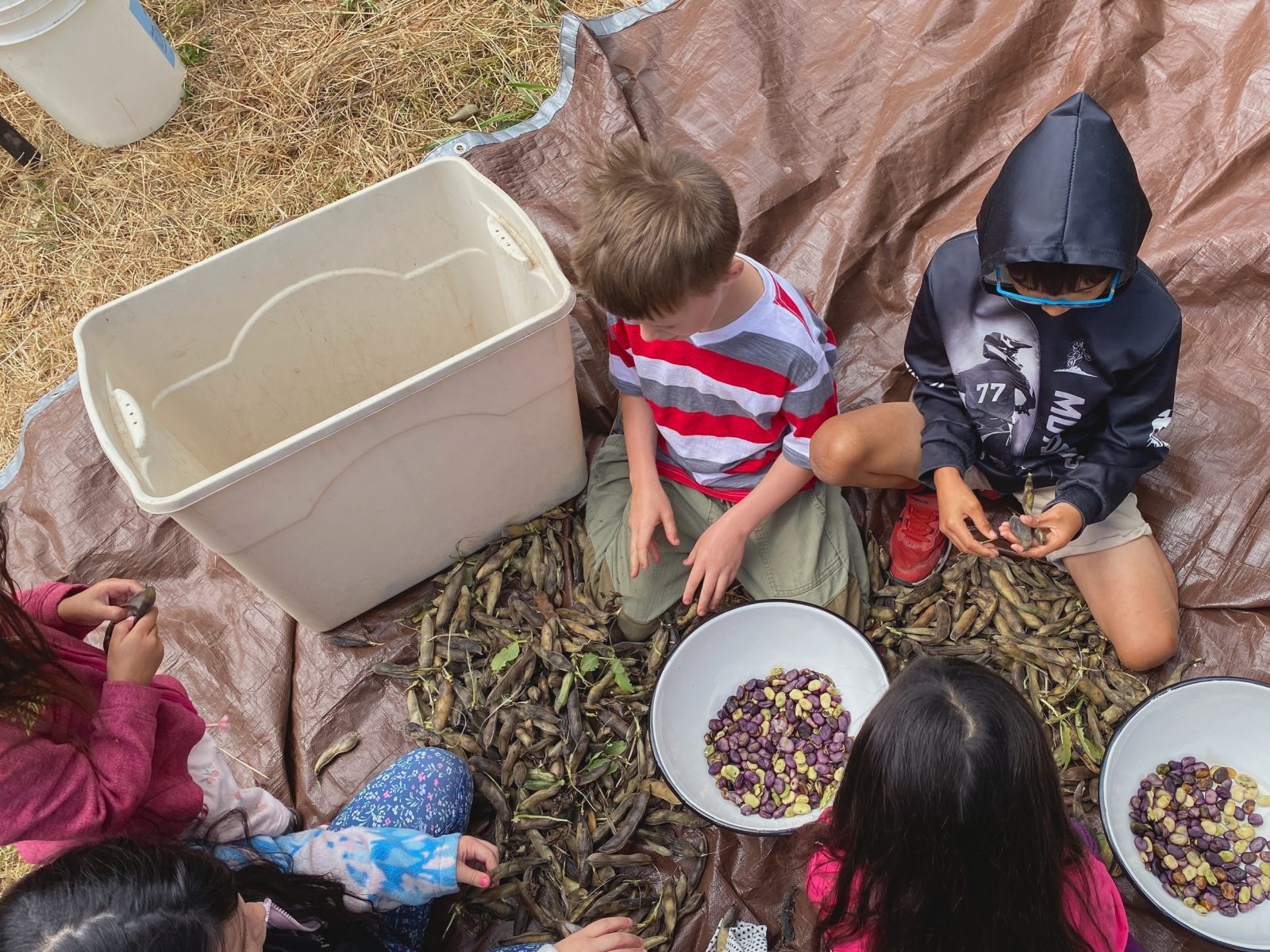
Beyond offering safer choices for our families and planet, beyond doing well in the garden and on the plate, heirloom seeds also offer stories that we gardeners can relate to. The stories help us connect to past generations. They help us see the beauty of seeds passing from hand to hand, sometimes far beyond our own lifetime. Heirloom seeds connect us with the past.
Sometimes those stories can be culturally nourishing and healing. Heirloom seeds come from all over the world, traveling with humans. Heirloom seeds and plants can help gardeners connect with their past and present culture through relationships with culturally significant plants in the garden and in the home.
Sowing Seeds for the Future
We started off this article by asking “What is an heirloom seed?” We discovered that the definition of heirloom seeds are subjective, but in the end we can agree that heirlooms come from long ago and they are not modern hybrids. We learned that as living breathing beings, heirloom varieties are changing over time, they are not static. Gardeners who save seed and seed farmers alike have the power to steward heirloom varieties.
In closing, I’d like to offer one final, more creative, dreamy definition of heirloom seeds:
Heirloom seed is a gardener’s direct relationship to the past and future through nurturing plants, saving seeds and sharing seeds in the present moment.
We are in relationship with a beautiful, wondrous home, this planet Earth. Just as a seed saver or seed farmer can affect the outcome of the seeds they steward, whether intentionally or unintentionally, the outcome of our lives is influenced by our actions, whether our actions are intentional or unintentional. (In reality a mix of both.)
Just as heirloom varieties are not static, so we humans are not static. When we perceive an heirloom variety as a static, unchanging thing to be reproduced perfectly season after season (like a factory producing uniform products), we are missing out on part of the beauty of dancing with life. We are missing out on embracing change and diversity that always happens whether we want it to or not.
Likewise, we may not want our own lives to change. We may get comfortable and choose not to risk change, especially as we age. We may stick with old, comfortable ideas that served us well all those years. (Which is one reason why our youth is so important for our culture’s ability to adapt.)
Anyway, change is happening, whether we are steering our lives or not. We are aging, whether we want to or not. One day we will all be dead, we will be compost to fertilize future generations, until eventually, hopefully far, far in the future, one day humans too will become extinct, just as our own planet and the sun it orbits around will one day die.
That is why I choose to embrace life and dance with nature, when I can be present enough, as uncertain as the outcome may be. I embrace the beauty all around me, if I can just remember to stop for a moment and notice it. I embrace life through growing seeds and breathing with the little babies as I kindle the nurturing spirit in my heart, so that the seed babies can also nurture me. These little green living miracles are not here in my garden for me. They are growing with me.
I’ll leave you with one last thought. (Thank you for reading to the end.)
Save seeds friends! Save seeds and share them. Share your stories about the seeds you grow so that the seeds can be planted and the stories can be retold. Save seeds from those chance volunteer seedlings you find and love as so many other gardeners before us did. Save seeds from your favorite plants. The seeds we save today will become the heirlooms of tomorrow. We are, after all, the living ancestors.
Seed Saving for Abundance
Want to learn how to harvest, clean & save your homegrown seeds? Become empowered to grow your own seeds for planting next season, stocking your pantry, sharing with your community, or selling to gardeners.
See our course Seed Saving for Abundance for more details!
Recommended Reading
This article is one of a series on the topic of seeds and diversity. You may also enjoy reading these other related topics:
- Seeds of Diversity: 5 Reasons to Embrace Genetic Diversity in our Gardens
- Hybrid Seeds: The Good, Bad and Ugly
- Open Pollinated Seeds: Out in the Open
- Locally Adapted Seeds: Apt to Thrive
- Grex: Seeds for Diversity and Change
- Landrace Gardening: Becoming Seeds of Place
Free Seed Saving Crash Course
Up your seed saving game in our free video: Seed Saving Made Simple We designed this presentation to help you have confidence knowing how to save seeds from your garden.
Free Seed Resources
We’ve put together a collection of stories, education and inspiration around gardening, living and working with seeds. They are all free and openly available for you to read and explore. Enjoy!





Share Your Thoughts